Selected Publications
Below are a selection of Dr. Babuška's papers and books curated by Leszek Demkowicz.
Papers
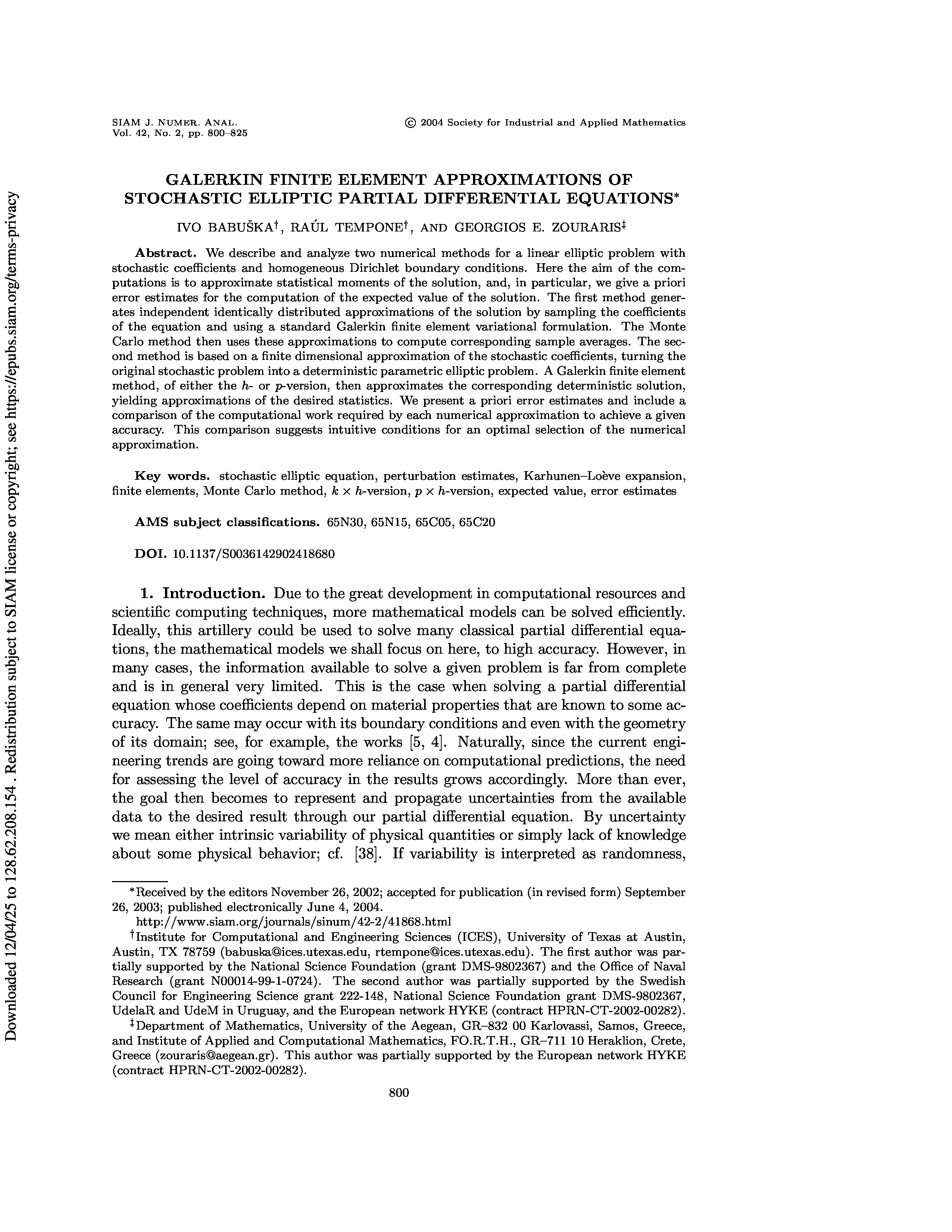
Galerkin Finite Element Approximations of Stochastic Elliptic Partial Differential Equations*
Abstract
We describe and analyze two numerical methods for a linear elliptic problem with stochastic coefficients and homogeneous Dirichlet boundary conditions. Here the aim of the com- putations is to approximate statistical moments of the solution, and, in particular, we give a priori error estimates for the computation of the expected value of the solution. The first method gener- ates independent identically distributed approximations of the solution by sampling the coefficients of the equation and using a standard Galerkin finite element variational formulation. The Monte Carlo method then uses these approximations to compute corresponding sample averages. The sec- ond method is based on a finite dimensional approximation of the stochastic coefficients, turning the original stochastic problem into a deterministic parametric elliptic problem. A Galerkin finite element method, of either the h- or p-version, then approximates the corresponding deterministic solution, yielding approximations of the desired statistics. We present a priori error estimates and include a comparison of the computational work required by each numerical approximation to achieve a given accuracy. This comparison suggests intuitive conditions for an optimal selection of the numerical approximation.
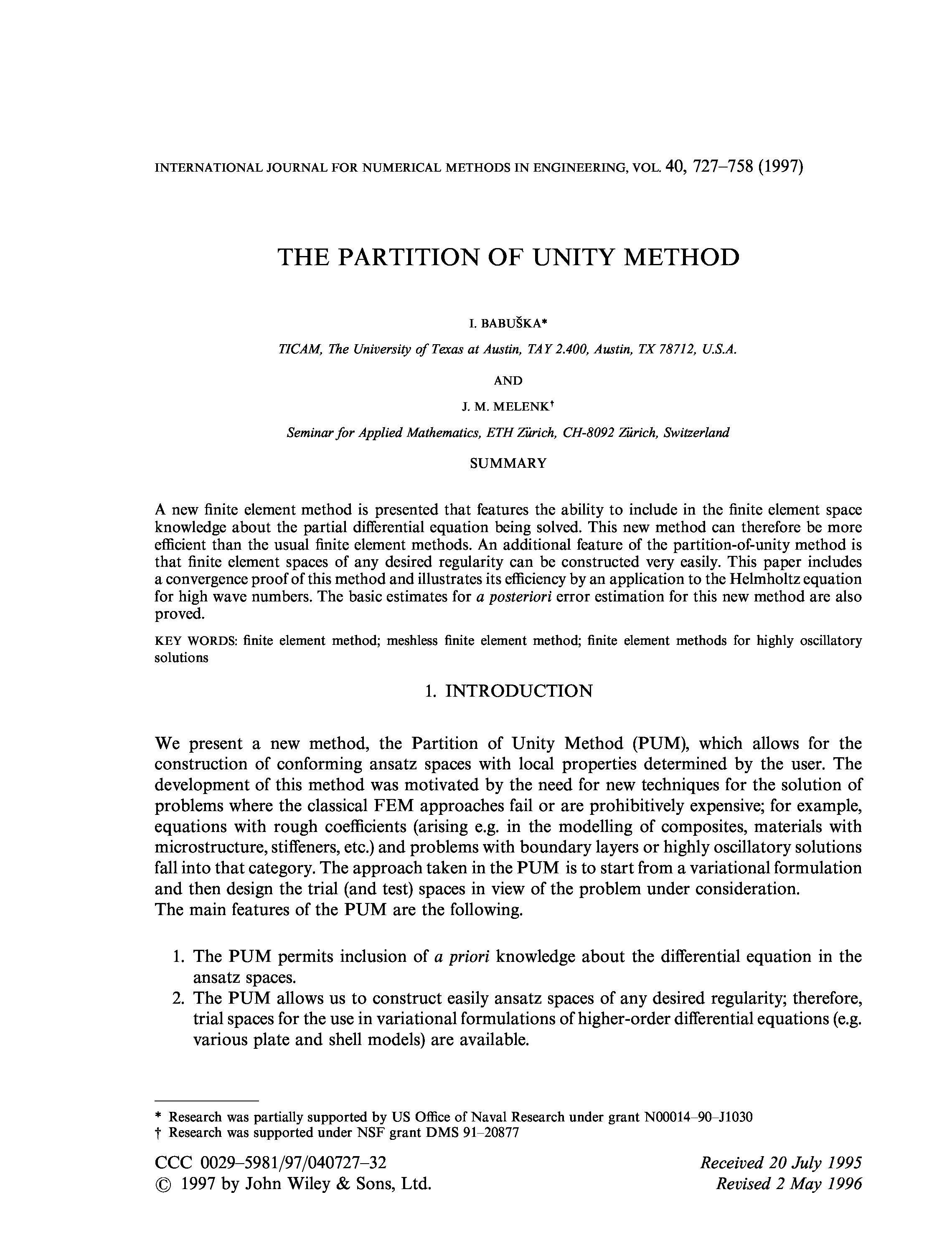
The Partition Of Unity Method
Abstract
A new finite element method is presented that features the ability to include in the finite element space knowledge about the partial differential equation being solved. This new method can therefore be more efficient than the usual finite element methods. An additional feature of the partition-of-unity method is that finite element spaces of any desired regularity can be constructed very easily. This paper includes a convergence proof of this method and illustrates its efficiency by an application to the Helmholtz equation for high wave numbers. The basic estimates for a posteriori error estimation for this new method are also proved.
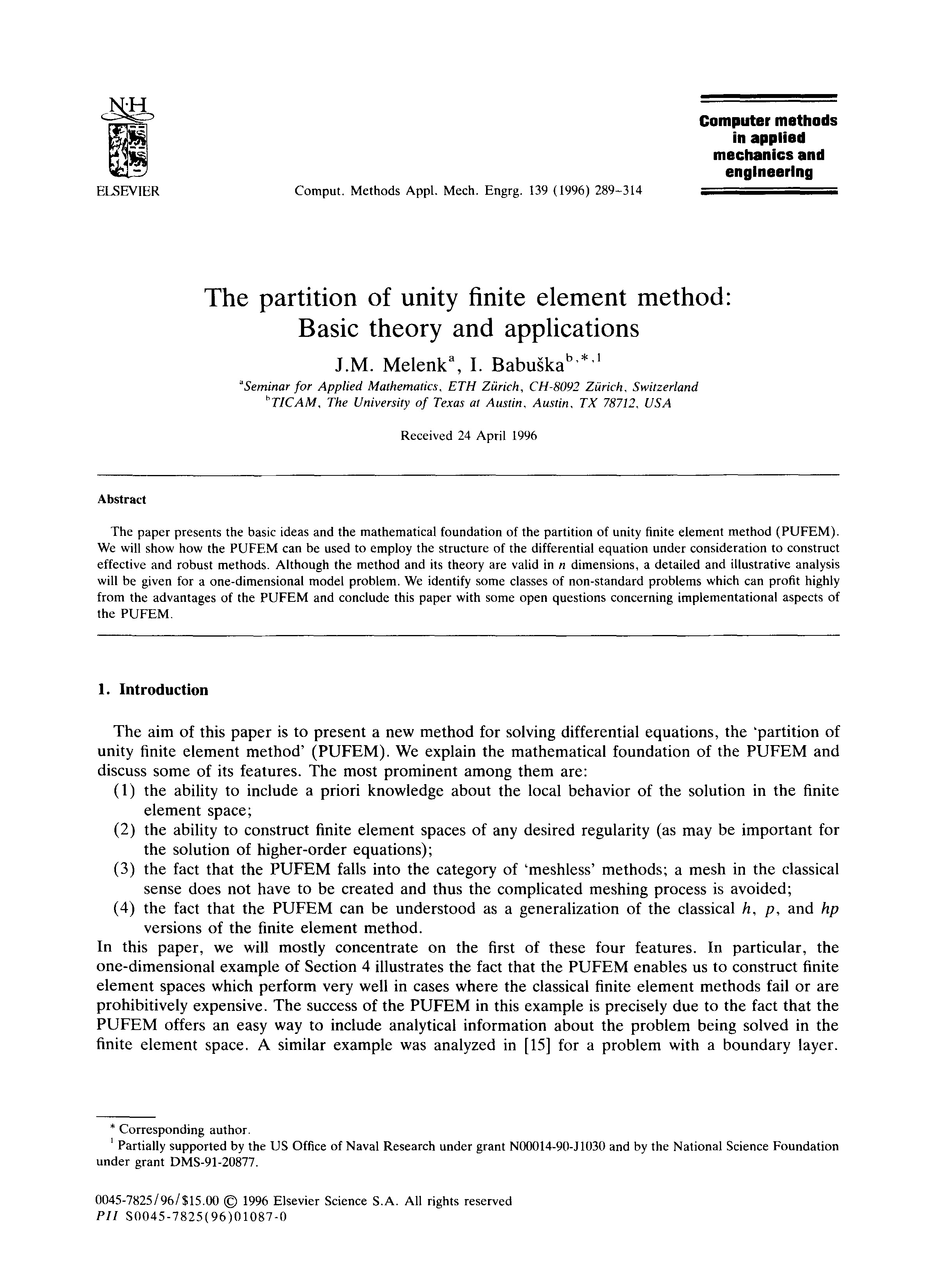
The Partition of Unity Finite Element Method: Basic Theory and Applications
Abstract
The paper presents the basic ideas and the mathematical foundation of the partition of unity finite element method (PUFEM). We will show how the PUFEM can be used to employ the structure of the differential equation under consideration to construct effective and robust methods. Although the method and its theory are valid in n dimensions, a detailed and illustrative analysis will be given for a one-dimensional model problem. We identify some classes of non-standard problems which can profit highly from the advantages of the PUFEM and conclude this paper with some open questions concerning implementational aspects of the PUFEM.
Finite Element Solution of the Helmholtz Equation with High Wave Number Part I: The h-Version of the FEM
Abstract
The paper addresses the properties of finite element solutions for the Helmholtz equation. The h-version of the finite element method with piecewise linear approximation is applied to a one-dimensional model problem. New results are shown on stability and error estimation of the discrete model. In all propositions, assumptions are made on the magnitude of hk only, where k is the wavelength and h is the step width of the FF_.~mesh. Previous analytical results had been shown with the assumption that k2h is small. For medium and high wavenumber, these results do not cover the mesh sizes that are applied in practical applications. The main estimate reveals that the error in Hi-norm of discrete solutions for the Helmholtz equation is polluted when k2h is not small. The error is then not quasioptimal; i.e., the relation of the FE-error to the error of best approximation generally depends on the wavenumber k. It is noted that the pollution term in the relative error is of the same order as the phase lead of the numerical solution. In the result of this analysis, thorough and rigorous understanding of error behavior throughout the range of convergence is gained. Numerical results are presented that show sharpness of the error estimates and highlight some phenomena of the discrete solution behavior. The h-p-version of the FEM is studied in Part II.
Special Finite Element Methods Fora Class of Second Orderelliptic Problems With Rough Coefficients*
Abstract
In this paper the approximate solution of a class of second order elliptic equations with rough coefficients is considered. Problems of the type considered arise in the analysis of unidi- rectional composites, where the coefficients represent the properties ofthe material. Several methods for this class of problems are presented, and it is shown that they have the same accuracy as usual methods have for problems with smooth coefficients. The methods are referred to as special finite element methods because they are of finite element type but employ special shape functions, chosen to accurately model the unknown solution.
THE PLATE PARADOX FOR HARD AND SOFT SIMPLE SUPPORT*
Abstract
This paper studies the plate-bending problem with hard and soft simple support. It shows that in the case of hard support, the plate paradox, which is known to occur in the Kirchhoff model, is also present in the three-dimensional model and the Reissner-Mindlin model. The paradox consists of the fact that, on a sequence of convex polygonal domains converging to a circle, the solutions ofthe corresponding plate-bending problems with a fixed uniform load do not converge to the solution ofthe limit problem. The paper also shows that the paradox is not present when soft simple support is assumed. Some practical aspects are briefly discussed.
The h-p Version of the Finite Element Method with Quasiuniform Meshes
Abstract
The classical error estimâtes for the h-version of the finite element method are extended for the h-p version. The estimâtes are expressed as explicit fUnctions of h and p and are shown to be optimal The estimâtes are given for the case where the solution u e Hk and the case when u has singularities at the corners of the domain.
THE p-VERSION OF THE FINITE ELEMENT METHOD*
Abstract
In the p-version of the finite element method, the triangulation is fixed and the degree p, of the piecewise polynomial approximation, is progressively increased until some desired level of precision is reached. In this paper, we first establish the basic approximation properties of some spaces of piecewise polynomials defined on a finite element triangulation. These properties lead to an a priori estimate of the asymptotic rate of convergence of the p-version. The estimate shows that the p-version gives results which are not worse than those obtained by the conventional finite element method (called the h-version, in which h represents the maximum diameter of the elements), when quasi-uniform triangulations are employed and the basis for comparison is the number of degrees of freedom. Furthermore, in the case of a singularity problem, we show(under conditions which are usually satisfied in practice) that the rate of convergence of the p-version is twice that of the h-version with quasi-uniform mesh. Inverse approximation theorems which determine the smoothness of a function based on the rate at which it is approximated by piecewise polynomials over a fixed triangulation are proved for both singular and nonsingular problems. We present numerical examples which illustrate the effectiveness of the p-version for a simple one-dimensional problem and for two problems in two-dimensional elasticity. We also discuss roundoff error and computational costs associated with the p-version. Finally, we describe some important features, such as hierarchic basis functions, which have been utilized in COMET-X, an experimental computer implementation of the p-version.
Error Estimates For Adaptive Finite Element Computations*
Abstract
A mathematical theory is developed for a class of a-posteriori error estimates of finite element solutions. It is based on a general formulation of the finite element method in terms of certain bilinear forms on suitable Hilbert spaces. The main theorem gives an error estimate in terms of localized quantities which can be computed approximately. The estimate is optimal in the sense that, up to multiplicative constants which are independent of the mesh and solution, the upper and lower error bounds are the same. The theoretical results also lead to a heuristic characterization of optimal meshes, which in turn suggests a strategy for adaptive mesh refinement. Some numerical examples show the approach to be very effective.
On The Angle Condition In The Finite Element Method*
Abstract
The finite element procedure consists in finding an approximate solution in the form of piecewise linear functions, piecewise quadratic, etc. For two-dimensional problems, one of the most frequently used approaches is to triangulate the domain and find the approximate solution which is linear, quadratic, etc., in every triangle. Acondition which is considered essential is that the angle of every triangle, independent of its size, should not be small. In this paper it is shown that the minimum angle condition is not essential. What is essential is the fact that no angle is too close to 180 degrees.
The Finite Element Method with Lagrangian Multipliers*
Abstract
The Dirichlet problem for second order differential equations is chosen as a model problem to show how the finite element method may be implemented to avoid difficulty in fulfilling essential (stable) boundary' conditions. The implementation is based on the application of Lagrangian multiplier. The rate of convergence is proved.
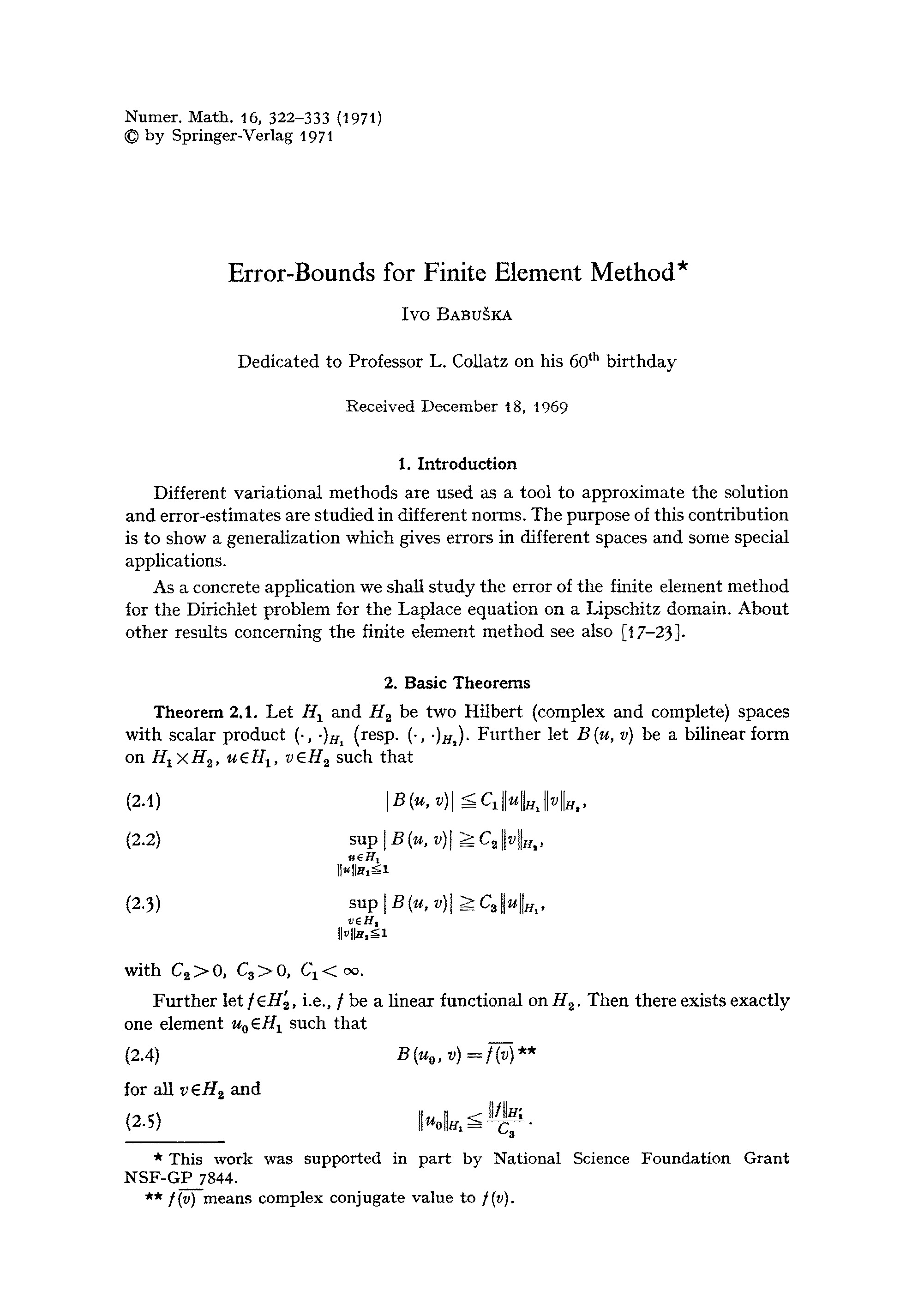
Error-Bounds for Finite Element Method*
Abstract
Different variational methods are used as a tool to approximate the solution and error-estimates are studied in different norms. The purpose of this contribution is to show a generalization which gives errors in different spaces and some special applications. As a concrete application we shall study the error of the finite element method for the Dirichlet problem for the Laplace equation on a Lipschitz domain. About other results concerning the finite element method see also [17-23].
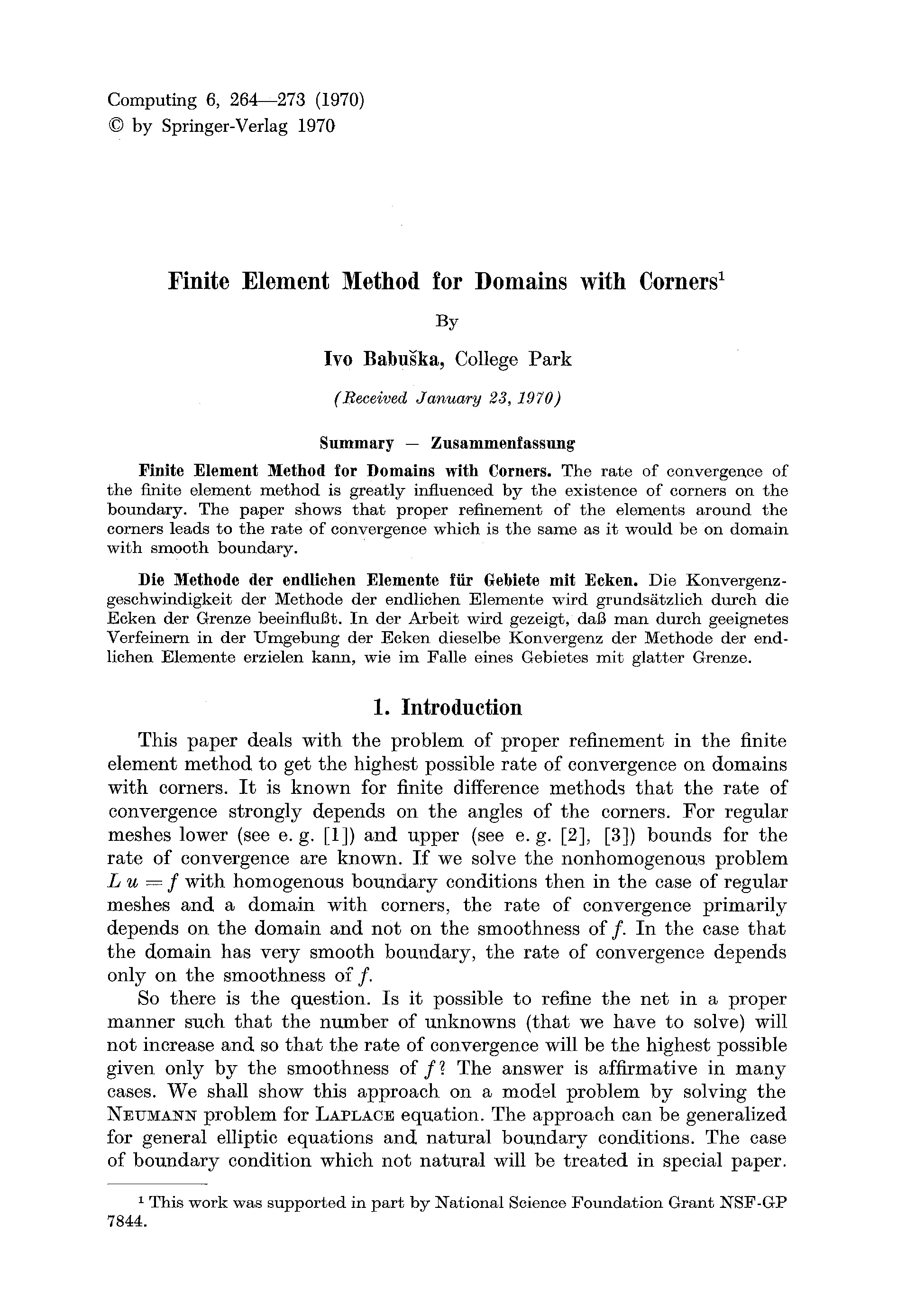
Finite Element Method for Domains with Corners
Abstract
Finite Element Method for Domains with Corners. The rate of convergence of the finite element method is greatly influenced by the existence of corners on the boundary. The paper shows that proper refinement of the elements around the corners leads to the rate of convergence which is the same as it would be on domain with smooth boundary.
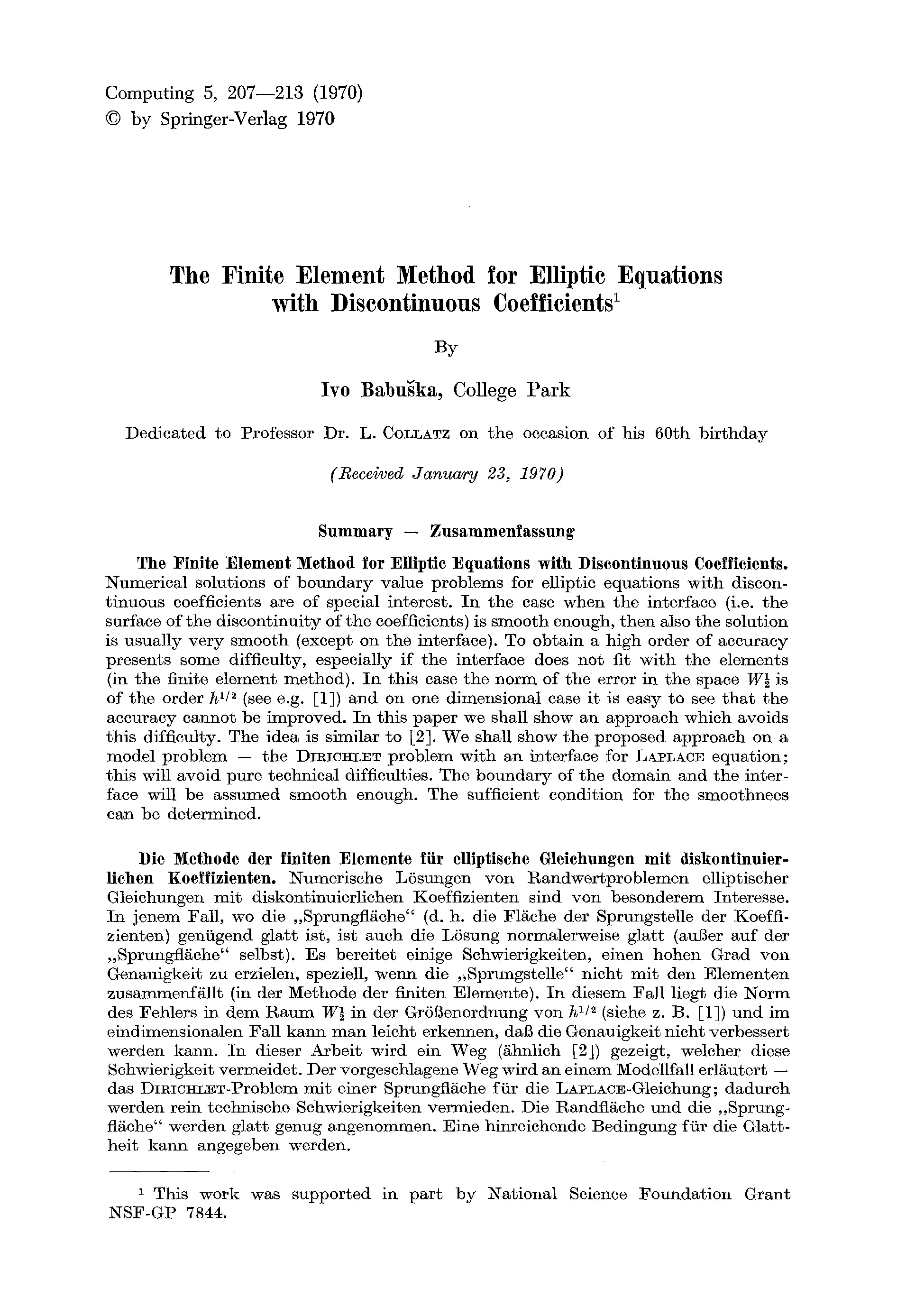
The Finite Element Method for Elliptic Equations with Discontinuous Coefficients
Abstract
The Finite Element Method for Elliptic Equations with Discontinuous Coefficients. Numerical solutions of boundary value problems for elliptic equations with discon- tinuous coefficients are of special interest. In the case when the interface (i.e. the surface of the discontinuity of the coefficients) is smooth enough, then also the solution is usually very smooth (except on the interface). To obtain a high order of accuracy presents some difficulty, especially if the interface does not fit with the elements (in the finite element method). In this case the norm of the error in the space W~ is of the order hl/~ (see e.g. [1]) and on one dimensional case it is easy to see that the accuracy cannot be improved. In this paper we shall show an approach which avoids this difficulty. The idea is similar to [2]. We shall show the proposed approach on a model problem -- the DII~ICHLET problem with an interface for LAPLACE equation; this will avoid pure technical difficulties. The boundary of the domain and the inter- face will be assumed smooth enough. The sufficient condition for the smoothnees can be determined.
Books
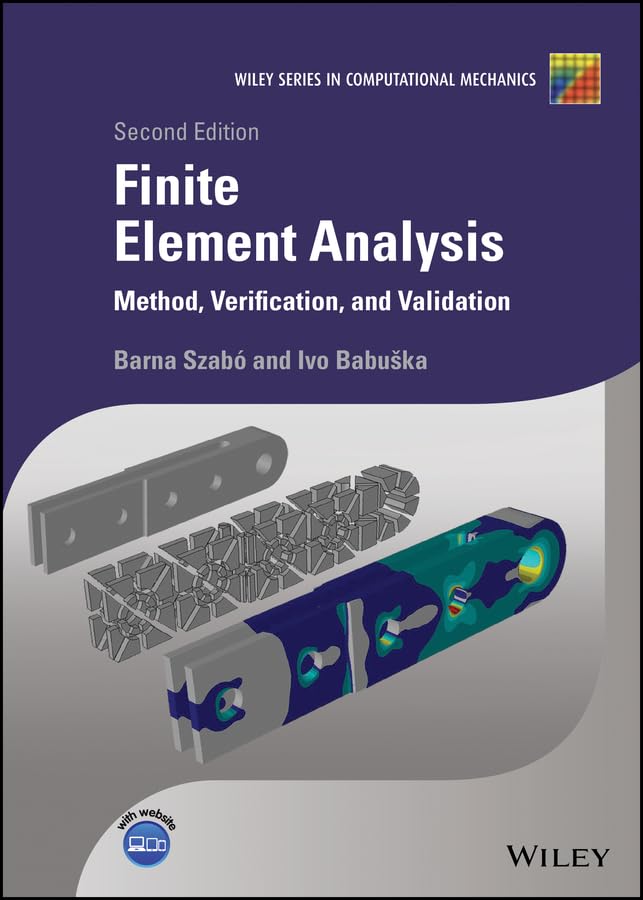
Finite Element Analysis (2nd Edition – “Method, Verification, and Validation”)
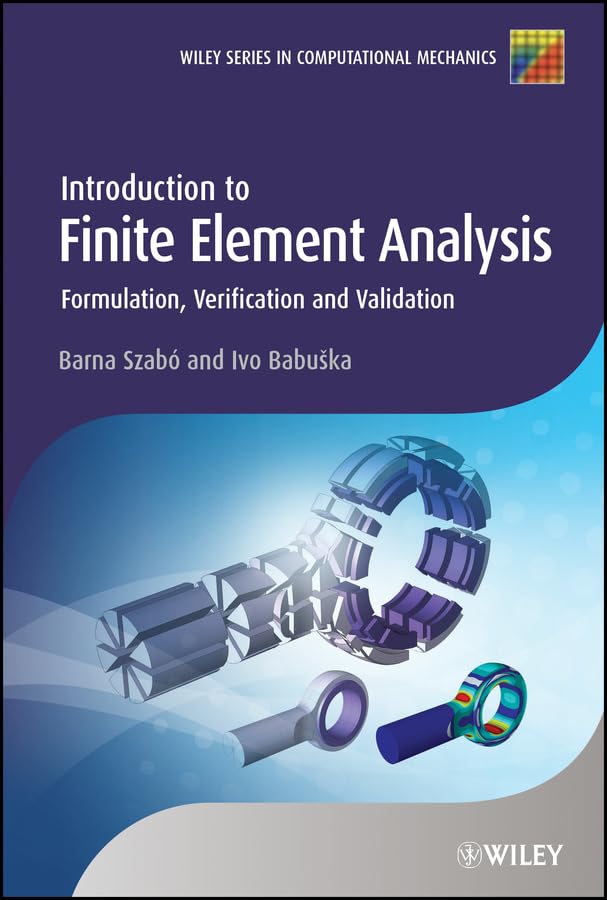
Introduction to Finite Element Analysis
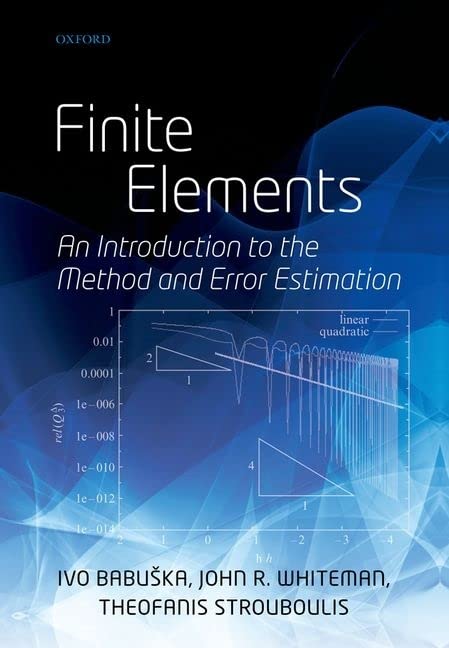
Finite Elements: An Introduction to the Method and Error Estimation